Identity
signs
Some common identity signs, established
by A. Berger (Signs in contemporary culture,1984, p.96) :
- flags: Singapour and China
(figure 1.3) ;
- food: red pistachios and chinese
sticks on the picnic table;
- symbols:the cross ...
(figure 1.2)
- architecture/buildings: the church
for Québec...;
- products or objects: the hockey
stick or skates for Quebec
(figure 1.4);
- context: the edge of water for
Bangladesh, Singapour, China, England, Perou... Quebec.
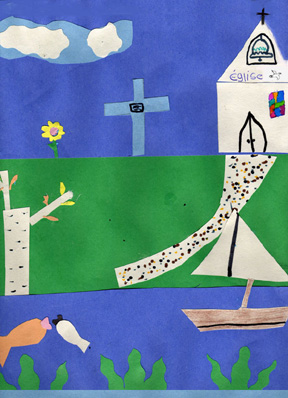
Figure 1.2
. Group 1 (young francophones): metaphoric process through the picture
representing a rural area during summer, by day, where objects like the
cross is linked to symbolic phenomena (the cemetery, the church...)
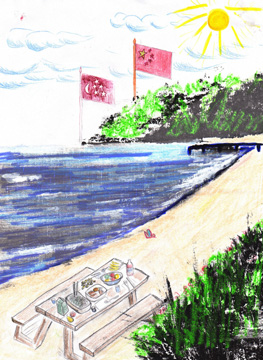
Figure 1.3. Group 2 (allophone adults):
perceptual exploration of the living (the butterfly), the moving (the water,
the flags...) and the static (the mountain... ).
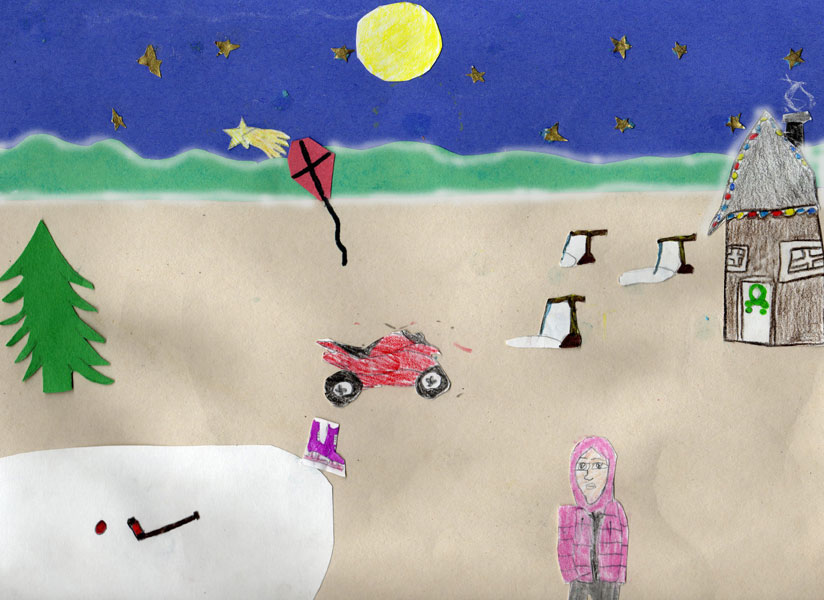
Figure 1.4. Group 1 (young francophones),
winter scenery by night on the lake.
Perceptual hierarchy:
- living (the person in the foreground),
- index of living (skates, hockey
stick, red 4x4),
- moving (a shooting star, a kite,
the smoke of the chimney...);
- static (the forest in the background,
the house, the fir tree...)
Which is the identy
sign common to all cultural groups that were implicated in the drawings
? If you want to validate yourself, write me.
|
Summary
"Strickly it (identity)
includes all things a person may legitimately and reliably say about himself-
his status, his name, his personality, his past life" (Orrin Klapp, 1969:
5, The collective search for identity)
This project
uses an innovative method of learning where pictures or iconic representations
are essential to solve some linguistic problems. Observational or vicarious
learning was at the heart of this project, helping acquiring new skills
with words and reinforcing cognitive, affective and social abilities.
Two groups
were involved: French schoolchildren, 11-12 years old, living in a rural
area near Montreal, and adult immigrants in a French immersion class in
Montreal. At first, the two groups , culturally, geographically and linguistically
separated, were initiated to poetic iconic universes from two illustrated
riddle and charade books. These books became models,
stimulating "active observation" in the students. Secondly, the first group
of children, divided in eight teams, were asked to create their own riddles
and charades along with an original background for each team reflecting
their own environment. Furthermore, they were asked to choose a season
and a time of day or night. Later, their work was submitted to the second
group of adult immigrants for validation. At the same time, these adults
created their own riddles on an already sketched background that they completed
with iconic signs reflecting their own patrimonial environment. Again,
their work was submitted to the first group for validation.
Conclusion
To search,
to explore, to progress, to discover are sources of pleasure for students
because they are intellectually stimulated (learning the heuristics of
discovering). Each of them has been able to discover rules, solutions and
ways of working in team. Our method of “active observation” and of “learning
by discovery” has helped the students to develop an intrinsic reward
feeling (Bruner 1979). We can confirm the usability of respecting
the visual hierarchy of living, moving and static (Almasy 1990)
while structuring reading or the creation process. This way of being guided
to read a picture, with a critical eye, allowed the participants to adjust
and enrich their decors, to establish a visual itinerary through this perceptual
exploration, which is independent of the eastern or western style of reading.
On the other hand, the structuring power of the picture and its codes confirmed
its cognitive and social role inviting an active participation of the young
students, maybe more so than of the allophone adults who already had their
repertoire of poetry from their culture of origin.
What we observe
is that an intercultural pedagogy , where a co-construction of knowledge
(Costanzo et Vignac, 2001) is possible, permits trainers and learners to
be actors and authors of new meanings and new practices. Working by team,
with a verbal opening (a season and a time of day or night) for the French
students and an iconic opening (already sketched sceneries) for the allophone
adults, has contributed to reinforce the identity of all students, to stimulate
a sense of "self-efficacy" (Bandura, 1997), along with the discovery of
self-imagination in drawing and writing riddles.
Six recommendations:
1. the usability
to work with iconic models as reference marks offering many details
to acknowledge/to develop active observation;
2. the effectiveness
to structure poetic writing by drawing sceneries as a metaphoric process
that allows objects of different nature to be brought together;
3. the pertinence
to identify a true intention of communication/establishing a contact
(virtual or real) with a given group;
4. the utility
to develop a group methodology where roles and responsibilities
of each are identified and cooperation encouraged;
5. the importance
to frame the conceptual work at the beginning by a verbal or iconic
opening (instructions and constraints), depending of the autonomy of
learners;
6. the cognitive
and cultural interest to acknowledge multiple meaning/responses,
when it is justified (depending of the context).
_________
Riddles created by the french
students (group 1), associated to their background in figure 1.2
1. Je protège
la pelouse et les fleurs
(I protect the grass and the flowers)
Car mon ruban de cailloux se fait
piétiner.
(for my pebble ribbon is being trample)
Qui suis-je?
(Who am I?= the path)
|
2. J’ai abrité
des fantômes et des trésors.
I sheltered ghosts and treasures.
Je connais la nuit, le jour, les
tempêtes et le beau temps
I know night and day, storms and
good weather.
Je suis souvent attendu.
I am often look forward (expected).
Qui suis-je?
Who am I ? (the boat, the church
or the cemetery?
|
Riddles created by the chinese team
(adult allophones/group 2), associated to their background in figure 1.3
1. Ce sont deux
frères
(They are two brothers)
Élancés et faits en
bois.
(They are hurled and made out of
wood)
La cuillère et la fourchette
sont leurs amis.
(The spoon and fork are their friends)
Ils travaillent côte à
côte.
(They work side by side)
Leur travail est d’aider à
déguster des choses délicieuses.
(Their work is to help us to taste
delicious things)
Qui sont-ils ? (Who are they? :
the Chinese sticks)
|
2.Une lune courbe
avec cinq étoiles.
A curved moon with five stars.
Le rouge contraste avec le blanc.
The red color contrasts with the
white one.
C’est très joli.
It is very prety.
Malgré le jour ou la nuit,
il flotte dans la moitié du ciel.
In spite of the day or night, it
floats in half of the sky.
Qui est-il? Who is it? (the Singapore
flag)
|
Riddles created by the french students,
associated to their background related to the figure 1.4
1. Je peux être
artificielle ou naturelle.
I can be natural or artificial.
Si tu fermes les yeux tu ne me vois
plus.
If you close your eyes you can't
see me anymore.
J’illumine le temps des fêtes.
I illuminate all festivals.
Tout le monde a besoin de moi.
Everybody needs me.
Qui suis-je? (Who am I?= the light) |
2. Je peux voler
(I can fly)
Mais je n’y arrive pas seul.
(but I am not able to do it alone)
Je peux être multicolore.
(I can be multicolored).
Je suis un bon divertissement
(I am a good entertainment)
Été comme hiver.
(in summer like in winter)
Qui suis-je? (Who am I?= the kite) |
MEDIAS REFERENCES
*Albums
Les cent plus belles devinettes,
Gallimard, France, 1983
Les devinettes d'Henriette,
HMH, Montréal, Qc. Canada, 2004
Monographs
ALMASY, P. ET COLL. 1990. Le photojournalisme.
Informer en écrivant des photos. Paris :
Éditions du CFPJ (Centre
de formation et de perfectionnement des journalistes).
BANDURA, A. 1997. Self Efficacy:
The exercise of control. New York. W.H. Freeman.
BERGER, A.A. 1984. Signs in contenporary
culture. An introduction to semiotics. New-York. Longman inc.
BRUNER, J. S. (1979). The quest
for clarity. In J. S. Bruner (Ed.) On knowing. Essays for the left
hand . Cambridge, MA: Harvard Univ.
Press (pp. 75-96).
COSTANZO, S ET L. VIGNAC 2001. «La
pédagogie interculturelle: revoir nos approches et
définir les objectifs essentiels».
Actes
du VIII Congrès de l’Association pour la Recherche InterCulturelle
(ARIC) Université de Genève? 24-28 septembre 2001.
|